


Resistance Training Is Not Just About Building Muscle
When most people hear Resistance Training, they picture dumbbells, gym benches and people trying to build bigger muscles. But strength plays a much bigger role in life than appearance.
The ability to climb stairs, carry groceries, play a sport, get up from the floor or remain independent later in life all depend, to some degree, on muscular strength.
What changes with age is not whether strength matters, but what we need strength for.
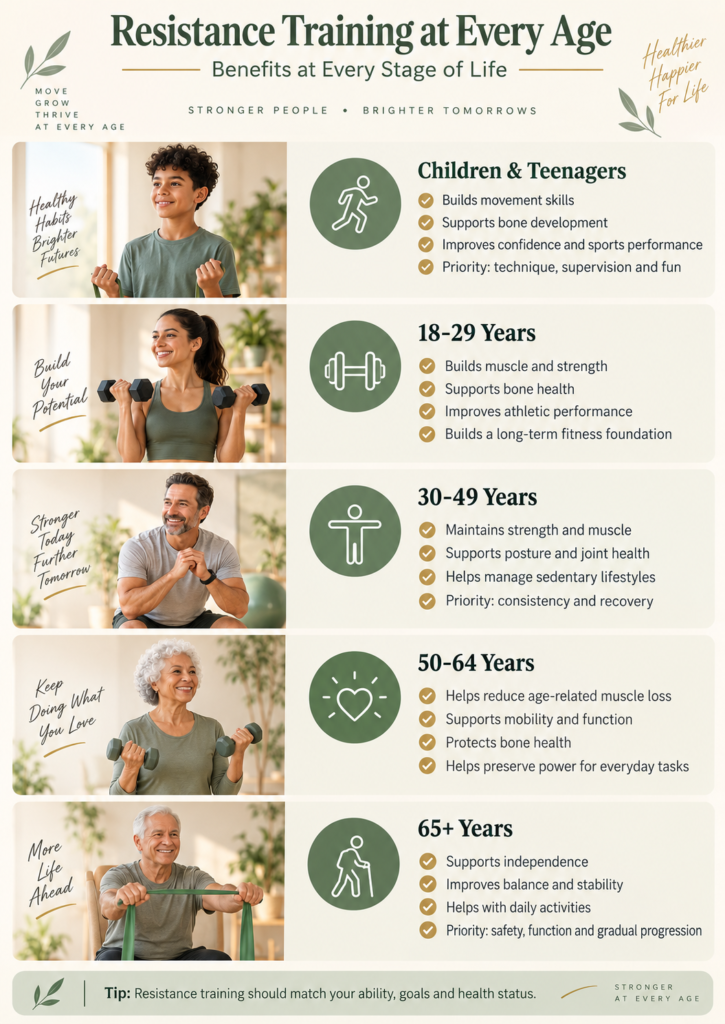
For a teenager, resistance exercise may help build movement skills and a strong physical foundation. For a young adult, it can improve strength and physical performance. By middle age, maintaining muscle and function becomes increasingly important. Later in life, strength can directly support mobility and independence.
That makes Resistance Training less of a temporary fitness activity and more of a lifelong investment in physical capacity.
How the Purpose of Resistance Training Changes With Age
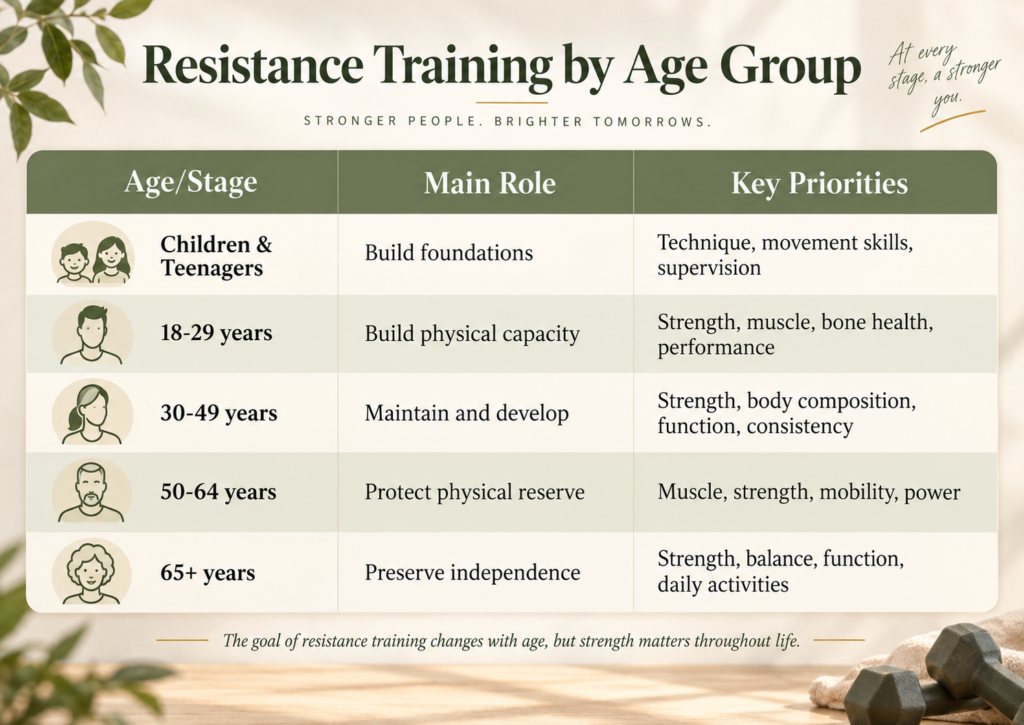
The role of Resistance Training changes as we move through life.
For children and teenagers, the focus should be on movement quality and learning good technique. In young adulthood, the goal often shifts toward building strength and physical capacity. During the 30s and 40s, consistency and maintaining function become increasingly important. In the 50s and 60s, protecting muscle and mobility becomes a priority. After 65, strength can play an important role in supporting independence and everyday activities.
Resistance Training for Children and Teenagers
One common misconception is that young people should completely avoid Resistance Training.
In reality, appropriately designed and supervised resistance exercise can be part of healthy physical development. The emphasis should not be on lifting the heaviest possible weight. Instead, children and teenagers should focus on learning how to move correctly and safely.
The National Strength and Conditioning Association emphasizes safe progression, proper movement, motor skills and foundational strength as important parts of long-term youth development.
Suitable activities may include bodyweight movements, resistance bands and appropriately loaded exercises performed with good technique.
The CDC recommends that children and adolescents include muscle-strengthening activity on at least three days per week as part of their overall physical activity.
The priorities at this age are:
- Learn correct movement patterns.
- Develop coordination and body control.
- Progress gradually.
- Keep exercise enjoyable.
- Use appropriate supervision.
- Avoid making maximum weight the main goal.
A useful way to think about youth training is this:
The question should not be “How much can you lift?” but “How well can you move?”
Resistance Training in Your 20s: Build Your Physical Reserve
Young adulthood is an excellent period to develop strength and overall physical capacity.
Resistance Training can help improve muscular strength, support muscle development and contribute to overall fitness. It can also complement sports, recreational activities and everyday physical performance.
But there is another way to look at training during your 20s.
Instead of thinking only about how your body looks today, think of the strength you develop as part of your physical reserve for the future.
The stronger and more capable you become now, the better foundation you may carry into later decades.
Training does not need to be overly complicated. The bigger priority is learning good technique, training consistently and progressing gradually.
Resistance Training in Your 30s and 40s: Strength Meets Real Life
This is often the stage when fitness begins competing with careers, family responsibilities, long working hours and increasingly sedentary routines.
The biggest challenge is often no longer understanding that exercise is beneficial.
The challenge is making it sustainable.
Resistance Training during these decades can help maintain muscular fitness, physical capacity and everyday function.
Current physical activity guidelines recommend that adults perform muscle-strengthening activities involving the major muscle groups on at least two days per week.
And importantly, resistance exercise does not have to mean spending hours in a gym.
Resistance can come from:
- Dumbbells
- Barbells
- Weight machines
- Resistance bands
- Bodyweight exercises
- Home workouts
For a busy adult, a realistic programme performed consistently is often more useful than an extremely demanding programme that cannot be maintained.
A useful mindset shift
Instead of asking:
“What is the perfect workout?”
ask:
“What type of training can I realistically continue?”
Consistency starts becoming one of the most valuable parts of the programme.
Resistance Training in Your 50s and Early 60s: Protect What Keeps You Moving
As we grow older, maintaining muscle, strength and physical function becomes increasingly important.
At this stage, the purpose of Resistance Training often begins to shift.
It becomes less about simply improving performance and more about protecting physical capability.
Think about everyday movements:
- Carrying luggage
- Getting out of a chair
- Climbing stairs
- Lifting household items
- Playing with children or grandchildren
- Maintaining balance after an unexpected step
All of these require muscular strength.
Power also matters. Power refers to the ability to produce force quickly—for example, standing up rapidly or reacting when you lose balance.
This is why maintaining strength through middle and later adulthood can have benefits far beyond the gym.
A powerful fitness goal for this stage of life is:
Stay capable of doing tomorrow what you can comfortably do today.
That may not sound as exciting as lifting a personal record, but it can become much more important with age.
Resistance Training After 65: Strength Becomes Independence
For older adults, the value of strength can become especially practical.
The CDC recommends that adults aged 65 and above perform muscle-strengthening activities on at least two days per week, alongside aerobic and balance-focused activity.
Regular physical activity can help older adults continue performing everyday tasks and support independent living.
Resistance Training may involve exercises such as:
- Sit-to-stand movements
- Resistance-band exercises
- Light dumbbells
- Machines
- Supported squats
- Step-ups
- Other functional strength exercises
The training does not have to look like the programme of a 25-year-old.
The important point is that it should match the person’s ability, goals, experience and health status.
The goal changes
At 25, strength may mean lifting more weight.
At 70, strength may mean confidently getting out of a chair, carrying shopping bags or climbing stairs without assistance.
Both are valid expressions of strength.
That leads to one of the most important ideas in this article:
Age is a reason to adapt Resistance Training—not automatically a reason to stop it.
The Biggest Difference Across Ages Isn’t Always the Exercise—It’s the Goal
Interestingly, some movements can remain similar throughout life.
Consider a squat.
A teenager may practise a squat to improve movement control.
A 25-year-old may use it to build strength.
A 40-year-old may use it to maintain physical capacity despite spending much of the day sitting.
A 70-year-old may practise a similar movement because it supports the ability to stand up from a chair confidently.
The basic movement may look familiar.
The reason for performing it changes.
That is why age-appropriate Resistance Training should not be based only on a number on a birth certificate.
It should also consider:
- Current ability
- Training experience
- Goals
- Technique
- Recovery
- Mobility
- Health status
The Real Benefit of Resistance Training: Keeping More Options Open
Muscle is often discussed in terms of appearance.
Strength is often discussed in terms of athletic performance.
But there is another way to think about both:
Strength gives you options.
For a child, it can support movement and physical confidence.
For a young adult, it can expand physical performance.
For a middle-aged adult, it can help preserve capability despite increasingly sedentary lifestyles.
For an older adult, it can support the ability to continue performing everyday activities independently.
The World Health Organization recommends muscle-strengthening activity across adulthood and also highlights the importance of strengthening and balance-related activity in later life.
So perhaps the better question is not:
“Am I the right age to start Resistance Training?”
Instead, ask:
“What should Resistance Training help me do at my age?”
That simple shift changes the entire purpose of exercise.
Start With the Stage You’re In
Resistance Training does not have to mean lifting extremely heavy weights or spending hours inside a gym.
At its simplest, it means asking your muscles to work against resistance and gradually giving them an appropriate reason to adapt.
Start with your current ability.
Learn good technique.
Progress gradually.
Allow adequate recovery.
And most importantly, choose an approach you can maintain consistently.
Because throughout life, the purpose of Resistance Training may change—
but strength continues to matter.
If you are new to exercise, have an injury, a medical condition or are unsure what type of Resistance Training is appropriate for you, consider seeking individual guidance from a qualified healthcare or exercise professional.
