


Stress Management Is Not About Eliminating Stress
A full inbox. A difficult conversation. Deadlines. Family responsibilities. Financial worries. A phone that never seems to stop demanding attention.
Stress can come from many directions at once.
That is why effective Stress Management is not about creating a life in which nothing stressful ever happens. It is about becoming better at recognizing pressure, responding to it and recovering before stress begins controlling the rest of your day.
The CDC’s current guidance on managing stress describes occasional stress as a normal part of life, while noting that long-term stress can contribute to worsening health problems. The encouraging part is that small daily actions can make a meaningful difference in how we cope.
The goal, therefore, is not:
“How do I stop feeling stressed?”
A more useful question is:
“How can I respond to stress in a healthier way?”
That small change in perspective is where Stress Management begins.
Stress Management vs Simply Escaping Stress
When we feel overwhelmed, our first instinct is often to escape the feeling.
Scroll through social media. Avoid the difficult task. Stay up late watching something. Ignore the conversation we need to have.
These actions may offer temporary relief, but relief and Stress Management are not always the same thing.
| Temporary Escape | Helpful Stress Management |
|---|---|
| Avoid the problem completely | Identify what can actually be changed |
| Scroll endlessly to switch off | Take an intentional mental break |
| Sacrifice sleep to finish everything | Protect recovery and prioritize |
| Keep worries entirely to yourself | Connect with someone you trust |
| Wait until stress becomes overwhelming | Notice early warning signs |
| Try to control everything | Separate what you can and cannot control |
Sometimes taking a break is exactly what we need. The difference is whether the break helps us recover and return, or simply postpones the pressure.
1. Start by Identifying What Is Actually Stressing You
“I am stressed” can describe many different experiences.
You may be overloaded with tasks.
You may be worried about something that has not happened yet.
You may be dealing with conflict.
Or perhaps nothing dramatic has happened—but poor sleep, constant notifications and weeks without genuine downtime have gradually reduced your capacity to cope.
Good Stress Management begins with specificity.
Instead of writing:
“Work is stressful.”
try:
“I have three deadlines this week and I don’t know which one should come first.”
The second statement gives you something to work with.
Ask yourself:
- What exactly is creating pressure?
- Can I influence it?
- Does it require action, acceptance or support?
- What is the smallest useful next step?
This prevents every source of pressure from becoming one giant mental problem.
2. Separate What You Can Control From What You Cannot
Some stress comes from situations we can change.
Other stress comes from uncertainty, other people’s decisions or events completely outside our control.
Trying to control both in the same way can be exhausting.
The World Health Organization’s Doing What Matters in Times of Stress programme teaches practical skills such as grounding, noticing difficult thoughts, making room for emotions and acting according to what matters. WHO notes that even a few minutes of practice each day can be useful.
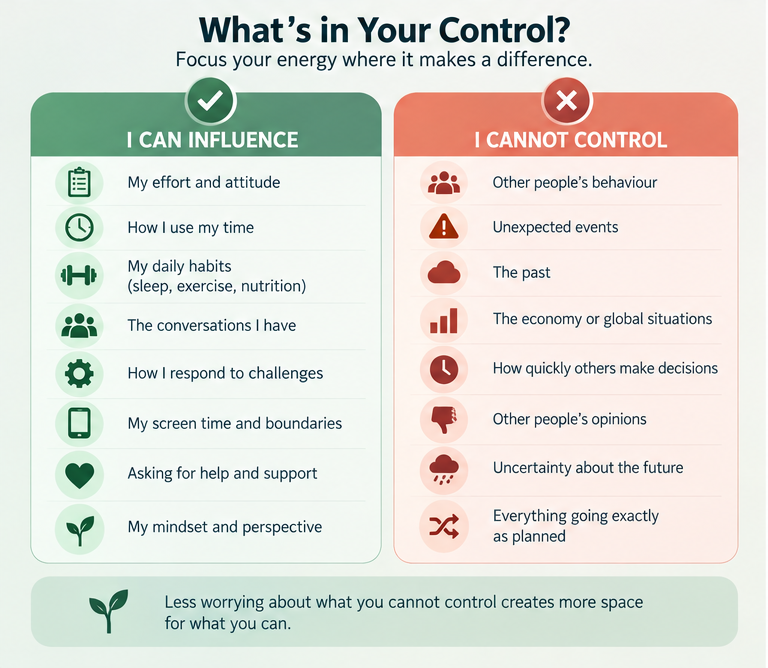
A practical approach is to divide your concerns into two columns:
I can influence this
Prepare for tomorrow’s presentation.
Ask for clarification.
Turn off notifications.
Go for a walk.
Have an important conversation.
I cannot control this directly
Another person’s reaction.
A decision already made.
The entire economy.
Whether everything goes exactly according to plan.
Stress Management becomes easier when your energy moves toward useful action rather than impossible control.
3. Give Your Body a Chance to Come Down From Stress
Stress is not only a thought.
It also has a physical component.
The U.S. National Center for Complementary and Integrative Health explains that the body’s stress response can increase heart and breathing rates. Relaxation practices such as slow breathing, progressive relaxation and guided imagery aim to encourage the opposite relaxation response.
You do not need a complicated ritual.
Try a short reset:
- Move away from the screen.
- Relax your shoulders and jaw.
- Breathe slowly and comfortably.
- Let your exhale become slightly longer.
- Spend two or three minutes paying attention to your breathing rather than the next task.
This will not remove the deadline.
But sometimes the best next decision is easier to make once your body is no longer behaving as though every email is an emergency.
4. Movement Is a Stress Management Tool Too
We often separate physical fitness and mental well-being, but everyday life does not.
The CDC includes physical activity among healthy ways of coping with stress and notes that staying physically healthy can support emotional well-being.
That does not mean every stressful day requires an intense workout.
Movement could be:
- A 20-minute walk
- Resistance Training
- Cycling
- Stretching
- Playing a sport
- Gardening
- Taking the stairs
- Simply getting outside after sitting for hours
The best activity is often the one you are willing to repeat.
Internal link opportunity: Link Resistance Training here to your existing Resistance Training for Different Agesarticle.
5. Protect Sleep Before Trying to “Optimize” Everything Else
Stress can interfere with sleep, and poor sleep can make the following day feel harder to manage.
That can become a frustrating cycle:
Stress → Poor Sleep → Less Energy → Lower Coping Capacity → More Stress
The CDC recommends consistent sleep schedules as part of healthy stress management and notes that adults generally need seven or more hours of sleep per night.
Before searching for another productivity technique, ask:
Am I giving myself enough opportunity to recover?
Simple steps include:
- Keep bedtime and wake time reasonably consistent.
- Reduce unnecessary late-night screen time.
- Avoid carrying unfinished work into bed whenever possible.
- Create a short wind-down routine.
- Write tomorrow’s priorities down rather than repeatedly rehearsing them mentally.
Sometimes Stress Management is less about adding a new habit and more about protecting recovery from everything competing with it.
6. Create Boundaries Around Your Attention
Modern stress is not always caused by one major event.
Sometimes it comes from never being fully off.
A work message during dinner. News before sleeping. Notifications while exercising. Emails checked during conversations.
Each interruption may be small, but together they fragment attention.
The CDC specifically suggests taking breaks from news and social media when constant exposure to negative information becomes upsetting.
Try creating small boundaries:
During work
Check messages at defined intervals instead of continuously.
During meals
Put the phone away for part of the meal.
Before bed
Create a short period without work-related communication.
During exercise or a walk
Allow some sessions to happen without constant digital input.
A useful Stress Management question is:
“Does everything that can reach me deserve immediate access to me?”
Usually, the answer is no.
7. Don’t Underestimate Connection
Stress often becomes heavier when carried alone.
Talking to someone does not automatically solve the problem. But another person can provide perspective, emotional support or simply space to express what has been building up.
The CDC recommends connecting with trusted people and talking about concerns and feelings as one healthy way of coping with stress.
Connection could mean:
- Speaking with a friend
- Spending time with family
- Asking a colleague for help
- Joining a supportive community
- Speaking with a counsellor or healthcare professional when needed
Seeking support is not the opposite of self-management.
Sometimes it is good Stress Management.
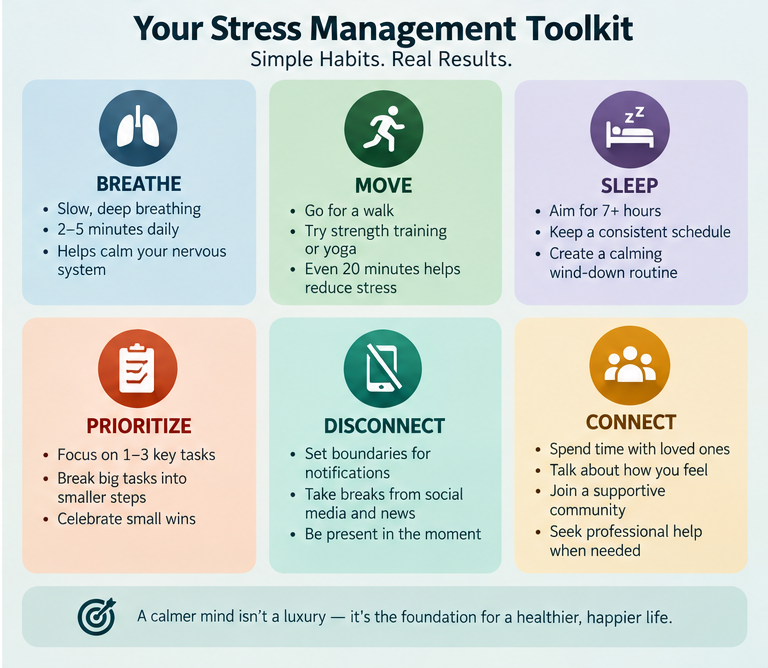
Build Your Personal Stress Management Toolkit
No single technique works equally well for every person or every stressful situation.
Instead, build a small toolkit.
| When You Notice… | Try… |
|---|---|
| Racing thoughts | Slow breathing or writing thoughts down |
| Physical tension | Walking, stretching or progressive relaxation |
| Too many responsibilities | Prioritizing the next 1–3 actions |
| Constant interruptions | Notification and screen boundaries |
| Emotional overload | Talking with someone you trust |
| Poor recovery | Protecting sleep and downtime |
| A problem you can solve | Take one concrete action |
| A situation you cannot control | Refocus on what you can influence |
The goal is not to use every technique every day.
The goal is to know which tool fits which kind of stress.
A Simple 10-Minute Stress Reset
When the day feels overwhelming, try this:
2 minutes — Pause
Move away from whatever is demanding your attention.
2 minutes — Breathe
Slow your breathing and release obvious physical tension.
2 minutes — Identify
Write down exactly what is creating the most pressure.
2 minutes — Decide
Choose one thing you can influence now.
2 minutes — Act
Take the smallest useful step.
This is intentionally simple.
Stress Management does not always require transforming your entire lifestyle. Sometimes you simply need to interrupt the cycle long enough to regain direction.
Better Stress Management Is About Recovery, Not Perfection
A well-managed life is not a stress-free life.
There will still be deadlines, uncertainty, difficult conversations and unexpected events.
The difference is whether every challenge accumulates—or whether you have habits that help you respond, recover and reset.
Pay attention to what triggers you.
Protect your sleep.
Move your body.
Create boundaries around your attention.
Stay connected.
Use relaxation practices when they help.
And distinguish between problems that require action and circumstances that require acceptance.
WHO’s latest 2026 guidance continues to recognize structured psychological self-help as an evidence-based way to expand support for people experiencing psychological distress, reinforcing the idea that practical coping skills can be learned and strengthened over time.
The aim of Stress Management is not to become someone who never feels pressure.
It is to become someone who knows what to do when pressure arrives.
Start With One Habit
Which part of your day creates the most unnecessary stress?
Choose one small change rather than ten ambitious ones.
Take a walk. Protect tonight’s sleep. Turn off one notification. Have the conversation. Take five quiet minutes. Ask for help.
Then notice what changes.
Explore more articles in our Mental Health section, or visit Join Us to connect with the Satwinder’s Legacy community and continue the conversation.
Everyday stress-management techniques are not a substitute for professional mental-health care. If stress feels persistent, overwhelming, significantly affects daily functioning, or you are concerned about your mental health, consider speaking with a qualified healthcare or mental-health professional.
