


An Entrepreneurial Mindset Starts Before the Business
A successful business may begin with an idea, but an Entrepreneurial mindset begins much earlier—with the way you notice problems, respond to uncertainty and turn possibilities into action.
You do not need to own a company to think entrepreneurially. A student developing a new solution, an employee improving a process, or someone turning a personal skill into an opportunity can all demonstrate Entrepreneurial thinking.
The European Commission’s EntreComp framework describes entrepreneurship as the ability to act upon opportunities and ideas and transform them into value for others. It organizes Entrepreneurial competence into three areas: Ideas & Opportunities, Resources, and Into Action.
That gives us a useful starting point: entrepreneurship is not only about having ideas. It is about developing the ability to recognise value, mobilise resources and act.
And this matters in a world where entrepreneurship is growing but survival remains challenging. The GEM 2025/2026 Global Report, based on more than 160,000 people across 53 economies, found strong startup activity globally while highlighting continuing challenges in building sustainable ventures.
The real question, therefore, is not simply:
“How do I start a business?”
It is:
“How do I learn to think and act entrepreneurially?”
Conventional Thinking vs Entrepreneurial Thinking
Planning is valuable. But when customers, markets and outcomes are uncertain, waiting until everything is perfectly known can stop progress completely.
An Entrepreneurial approach combines thinking with experimentation.
| Conventional Thinking | Entrepreneurial Thinking |
|---|---|
| Wait for the perfect opportunity | Look for problems worth solving |
| Focus on resources you lack | Start with resources you already have |
| Try to predict every outcome | Test assumptions and adapt |
| See failure mainly as loss | Use controlled failure as information |
| Protect the original plan | Change direction when evidence changes |
| Avoid uncertainty | Learn to operate intelligently within it |
The important distinction is not planning versus no planning.
It is knowing when information can be researched in advance—and when the only way to learn is to take a small action and observe what happens.
1. Entrepreneurial People Notice Problems Others Ignore
Everyday frustration can contain information.
A slow service, confusing buying process, underserved customer group or repetitive task may simply look annoying to most people. An Entrepreneurial thinker becomes curious:
Why does this problem exist, and could it be solved better?
EntreComp identifies spotting opportunities, creativity, vision and valuing ideas as core Entrepreneurial competencies.
A simple habit can help develop this skill.
Keep a problem notebook for a week and record situations where people experience:
- wasted time,
- unnecessary expense,
- inconvenience,
- confusion,
- poor service,
- or unmet needs.
Do not immediately try to invent businesses.
First train yourself to observe more carefully.
Opportunities often become visible only after you become better at noticing the problems behind them.
2. Start With What You Already Have
Many ideas never begin because people focus first on what they lack.
“I need more money.”
“I need the right partner.”
“I need better connections.”
“I need the complete plan.”
Entrepreneurship researcher Saras Sarasvathy’s Effectuation approach offers a different starting point. Its “Bird-in-Hand” principle encourages entrepreneurs to begin with three questions:
Who am I?
What abilities, interests and experiences do I possess?
What do I know?
What knowledge or expertise can I use?
Whom do I know?
Which relationships and networks could help me take the first step?
Effectuation research argues that expert entrepreneurs often begin with available means rather than waiting until all ideal resources are assembled.
This produces an important Entrepreneurial principle:
Action can help attract resources that were unavailable before you started.
3. Think in Experiments, Not Just Plans
Suppose you believe students would pay for a particular service.
You could spend six months building a sophisticated platform.
Or you could first speak with 20 students and test whether the problem is important enough that anyone would actually pay to solve it.
The second approach produces information much faster.
Entrepreneurial experimentation means reducing a large uncertain decision into smaller, cheaper questions.
Instead of:
“Will my business succeed?”
ask:
- Do customers actually experience this problem?
- Who experiences it most?
- Will they try the solution?
- Will they pay?
- What part of the idea do they value?
- What would make them reject it?
This turns uncertainty into a learning process.
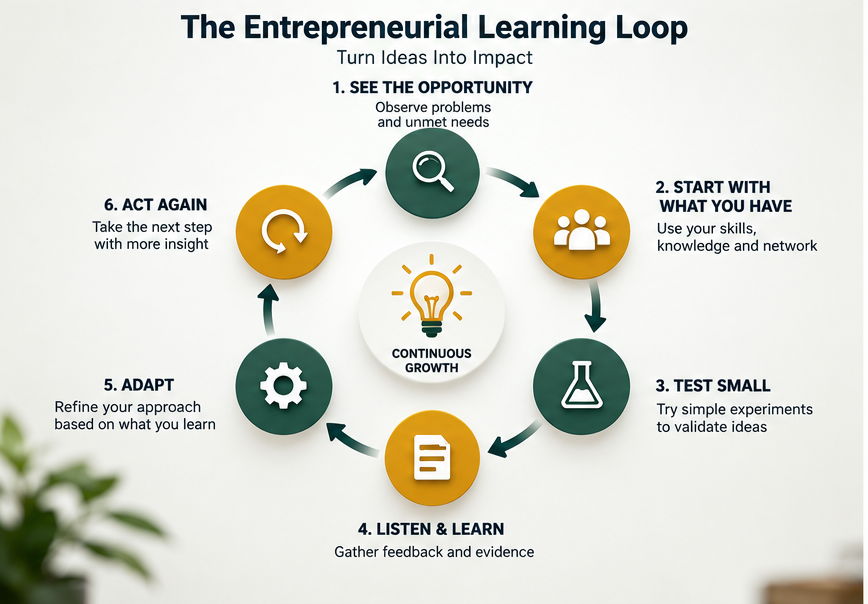
4. Take Risk—But Make Failure Affordable
Being Entrepreneurial does not mean being reckless.
One of Effectuation’s most useful principles is Affordable Loss. Instead of deciding only on the basis of potential returns, ask how much time, money or effort you can reasonably risk if an experiment does not work.
For example, rather than investing ₹5 lakh before validating demand, perhaps the first experiment can be performed with ₹5,000.
Rather than quitting a job immediately, perhaps a service can first be tested with a small group of customers.
The objective is not to eliminate risk.
It is to make the cost of learning manageable.
That changes failure from catastrophe into feedback.
5. Entrepreneurial Growth Depends on People
Networking is often treated as collecting LinkedIn connections or exchanging business cards.
But an Entrepreneurial network should create value.
A customer can reveal a hidden problem.
A supplier can suggest an alternative.
A mentor can challenge a weak assumption.
A collaborator may contribute skills you do not possess.
Effectuation describes this partnership-building approach through the Crazy Quilt principle: people who commit to an emerging opportunity can bring new resources and even influence what the venture eventually becomes.
So instead of asking:
“What can this person give me?”
try asking:
“What could we create together?”
That mindset produces stronger relationships—and often stronger opportunities.
6. Build Skills, Not Just Confidence
Motivation is useful, but confidence alone does not create a sustainable business.
Entrepreneurs need skills.
The OECD notes that skills development and lifelong learning are increasingly important for the competitiveness and resilience of entrepreneurs and small businesses as digital technologies, sustainability and changing markets reshape business environments.
Useful Entrepreneurial capabilities include:
- Opportunity recognition
- Communication
- Financial understanding
- Selling and negotiation
- Digital skills
- Decision-making
- Creativity
- Leadership
- Collaboration
- Adaptability
- Learning from feedback
You do not need to master them all before beginning.
Often, starting reveals which skill you actually need next.
Entrepreneurial Mindset: Myth vs Reality
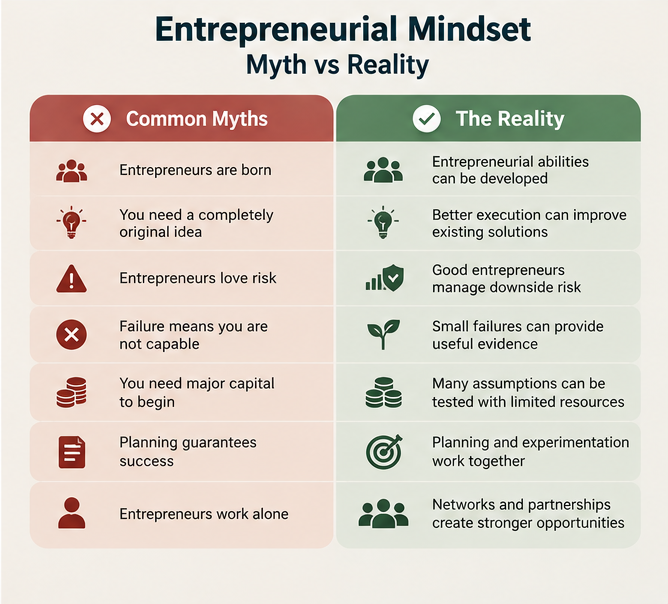
This is an important perspective because an Entrepreneurial mindset is not a personality type.
It is a collection of behaviours that can become stronger through experience.
A Simple Entrepreneurial Exercise
Choose one problem you have noticed recently.
Then answer five questions:
- Who experiences this problem?
- Why does it matter to them?
- What resources do I already have?
- What is the smallest possible solution I could test?
- What evidence would make me continue, modify or abandon the idea?
Then do one thing that cannot be completed entirely inside your head:
Talk to someone who actually experiences the problem.
That conversation may be worth more than another ten pages of planning.
Think Less About Becoming an Entrepreneur—Become More Entrepreneurial
Entrepreneurship is often presented as a title:
Founder. CEO. Business Owner.
But before it becomes a title, it is a way of approaching the world.
Notice opportunities.
Start with what you have.
Take manageable risks.
Test rather than assume.
Listen carefully.
Build relationships.
Learn continuously.
Adapt when the evidence changes.
Most importantly, turn ideas into action.
An idea sitting inside your head has potential. An idea tested in the real world begins producing knowledge and value.
So instead of waiting for the perfect Entrepreneurial opportunity, ask yourself:
What is one small idea I can test this week?
Explore more articles in our Entrepreneurship section, or visit Join Us to connect with the Satwinder’s Legacy community about an idea, opportunity or potential collaboration.
